To buy a plot of land for building a house somewhere in good locality of Lalitpur costs around NRs 1.5 Crore for which a Civil Servant of Nepal has to pay saving earnings of around 35 years. The price of land on the highway of Bhaktapur district has increased to 7000% now. Even by adjusting the inflation rate, the price is too high. Why is Real Estate expensive in Nepal?
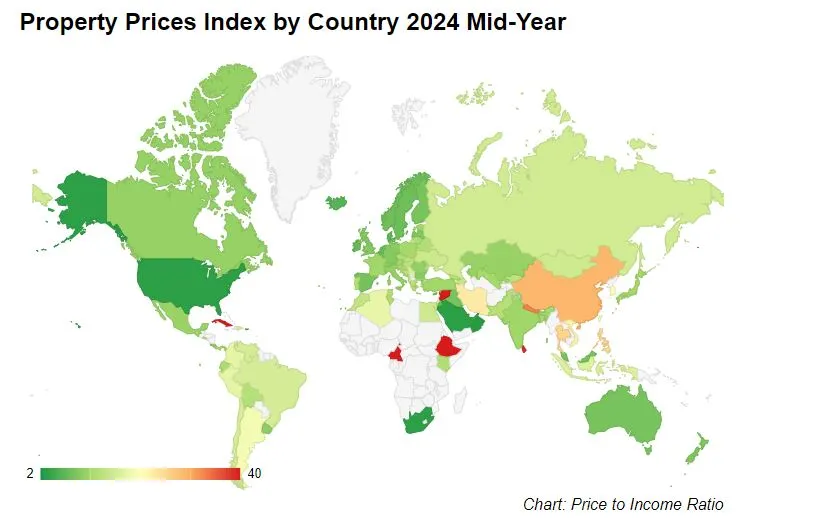
The Property Price to Income ratio of Nepal is 33.28 which is too high and Nepal lies in 6th Position in 2024 (Source: Property Prices Index by Country 2024 Mid-Year)
From 2003 to 2008, Property Prices in Kathmandu Valley surged by nearly 300%, according to the Nepal Land and Housing Developers’ Association. A report by Nepal Rastra Bank shows doubling of land prices in every 3.5 years growing at the rate of 27.7% annually. Price is also higher in other urban areas of Nepal especially in Terai regions. It’s now common to hear residents express their frustration over the difficulty of affording property in the cities of Nepal.
Why is Real Estate expensive in Nepal?
There are several key factors driving this trend, with three standing out. First, consider the mass migration. During the Maoist insurgency (1996–2006), many rural inhabitants fled to the cities from remote areas for safety. It’s estimated that around 500,000 people were displaced from remote places during this period. As these people settled permanently in Kathmandu and other major cities, the demand for land and housing surged, causing prices to skyrocket. Furthermore, the migration trend from rural to urban areas continues in search of economic opportunities. Rural residents sold their assets to purchase property in the city, pushing up demand.
Additionally, banks and financial institutions contributed to the price hike by offering easy credit, leading more people to invest in real estate for higher returns. Between 2007 and 2009, real estate loans jumped from NRs 2.48 billion to NRs 24.76 billion. Some critics even argue that the banks’ practices, such as renewing bad loans, exacerbated the price surge.
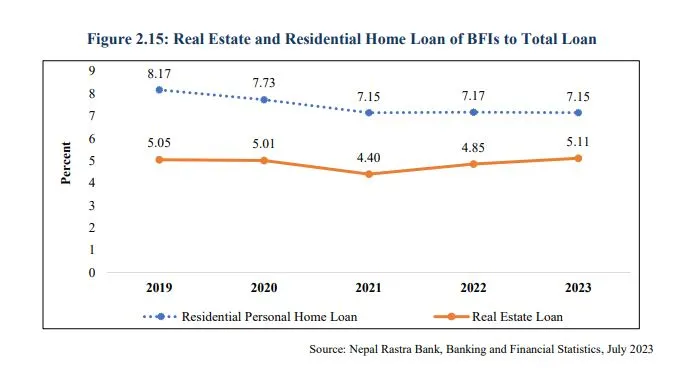
Recognizing the risks to financial stability, Nepal’s central bank implemented stricter policies, reducing commercial banks’ exposure to real estate lending from 19.40% to 12.74% between 2010 and 2019, 12.26% in 2023.
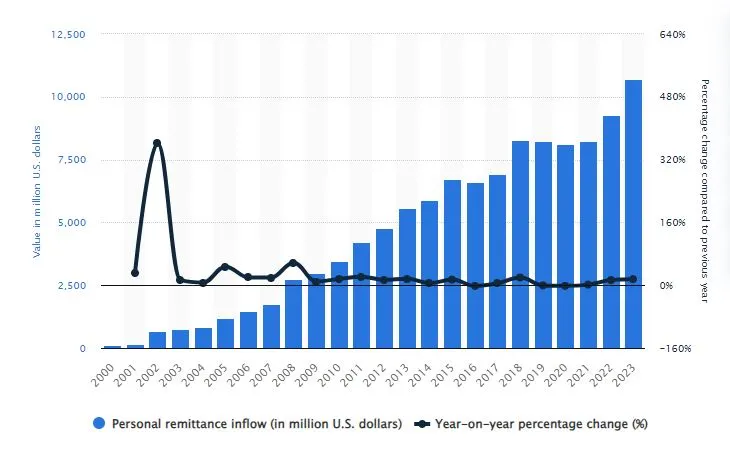
Despite these measures, other sources of capital, particularly remittances, continued to fuel the market. Remittance income surged from $678.5 million in 2002 to $8,200 million in 2018 and got stagnant till 2021 and again increasing to $10,725 million by 2023, driving up household savings and adding to the pool of money available for real estate investments.
Due to lack of investment culture in other productive sectors, household savings are diverted to Real Estate sector buyings lands and houses. As a result, the frequency of real estate transactions has increased, with land being fragmented into smaller, sellable plots. Investors, wealthier individuals, and even politicians continue to invest in property, betting on future price hikes. In fact, this trend mirrors the global rise in property values, as evidenced by the IMF’s house-price index, which has surpassed pre-2007-09 financial crisis levels.
However, there’s growing uncertainty about how long this boom will last. While the central bank has capped real estate loans to curb excessive exposure, limiting them to 25% of total loans, it has become harder for many to secure financing. This has raised questions about whether property prices may soon stabilise.
Despite the regulatory measures, the surge in Nepal’s real estate market seems to reflect deeper economic shifts. The dramatic price rises of the 2000s were driven by factors like migration, urbanization, economic opportunities. These same forces appear to be at play today, and they may continue to fuel further price hikes.
A closer look at household finances reveals that higher-income individuals are driving much of the current price growth. The trends set in the 2000s have carried forward, with only slight slowdowns during the early 2010s due to lending controls. While some investors sold off properties to pay debts, the market itself never truly crashed – buyers merely delayed their purchases, and sellers refused to lower their prices. After Government banned partition of land in 2018, somehow land transactions have been slowed down but complete partition could not stop due to loopholes in policies. But the economic slow down of the country however has slowdown the property sales transactions. It seems the stagnation in prices of land since 3/4 years but has not effectively lowered the price.
The most critical factor keeping property prices elevated, however, is the significant imbalance between supply and demand. A small group of powerful players dominates the market, while ineffective land-use and pooling laws prevent an adequate housing supply. This has led to a sharp increase in prices without a corresponding rise in available housing units. Estimates suggest that Kathmandu Valley needs thousands more homes to meet growing demand.
Meanwhile, the government’s focus has been more on taxing land transactions than addressing the housing shortage. One of the main source of revenue for Nepal Government is collected from land registration and capital gains taxes. Without significant reforms or government intervention, the upward trend in real estate prices seems likely to continue.
Advertisement:
Get In Touch With Us
Fill out this form for other similar informations. We will also help you to buy or sell property in Nepal.
Join The Discussion